
Trace Adams County Former Owners by Transfer
A transfer log is the tool that holds the whole effort together. Work from the current deed backward, and each time you find a transfer, the seller becomes the next buyer you hunt for. Adams County publishes no confirmed online deed index with a firm starting year, so note where each link actually came from rather than assuming the web carries the full run.
| Transfer date | Grantor to grantee | Deed type | Book/page |
|---|---|---|---|
| Newest confirmed recording | Prior owner to present grantee | Copy the instrument label | Current deed citation |
| Next earlier recording | Earlier owner to prior owner | Warranty, quitclaim, or other label | Earlier deed citation |
| Probate or court branch | Estate or authorized party to successor | Order, executor deed, or heir deed | Case plus recorded citation |
| Archive-era link | Historic grantor to grantee | Deed, patent, or territorial record | Book, reel, box, or item |
Treat the log as a live worksheet, never a finished sample. Enter only records tied to the subject land, and copy the clerk's spelling and instrument wording exactly as written.
Carry Adams County Parcel Clues to the Deed Books
Property Link gives you the raw starting material: owner of record, situs address, PPIN, parcel number, legal description, section-township-range, and any book/page shown. Remember what it is. The assessment portal is not a deed index. An appraisal record cannot prove who owned the parcel before the current entry.
An assessment card can still carry a Chancery book and page citation. Write it down before you leave the screen. At every step, match the land description itself. Shared surnames, initials, estates, and entity owners invite false links.
Note: Keep every space and embedded letter in an Adams parcel number intact, since reformatting it can break an exact match.
Reconstruct the Adams County Deed Chain in Reverse
The official land-record home is the Adams County Chancery Clerk. Records may be inspected at 115 S Wall Street in Natchez, weekdays from 8:00 a.m. to 5:00 p.m. The county publishes no public online grantor-grantee index, so plan on the counter or a narrowly written request.
- Locate the deed into the current owner by searching that party as grantee.
- Record grantor, grantee, date, book/page, deed type, and full legal description.
- Search the grantor as a grantee in an earlier period for that predecessor's acquisition.
- Reconcile acreage, lot and block, section data, map references, and prior-deed citations.
- Branch into probate, partition, foreclosure, tax sale, correction, or replat files when directed.
- Resume the chain and stop only at a documented origin or an honestly labeled archive gap.
- Grantor / grantee
- The transferring party and the party receiving the recorded interest.
- Chain of title
- The linked sequence of instruments affecting the same land.
- Reverse index
- The grantor-side index used to follow a prior owner after locating that person's acquisition.
- Warranty / quitclaim
- Different deed forms whose effect must be read from the instrument, not inferred from its label.
No Verified Online Cutoff for Adams County Previous Owners
No official Adams County web deed index or confirmed starting year exists. Property Link and GeoPortal are assessment tools. Delta's circuit portal serves court, marriage, and judgment indexes. None of them delivers a complete online history of former owners.
Coverage limit. Adams County publishes no verified online deed cutoff; older and current links may require Chancery books, indexes, microfilm, or a written request.
Call 601-446-6684 with exact names, the approximate period, the legal description, and any book/page clues. Ask which index volume or image access exists and get a current fee quote.
Move Adams County Ownership History Into MDAH
The MDAH Adams finding aid describes county records dated 1777-1974 plus a broader series dated 1799-1980. Holdings named there include territorial material, assessed-valuation and ownership changes, early court dockets, a plantation title abstract, and maps. Those dates describe what the archive holds, not seamless deed coverage.
After the clerk's books, the MDAH county microfilm catalog is the next stop. Filter for Adams County, pick the book or index you need, and confirm reel coverage with staff. The Media Room handles courthouse-record microfilm research.
The Adams digital series lists items from several early nineteenth-century years. Read each description before counting it as a deed or owner index.
See the Adams County Archive Finding Aid
The MDAH Adams County record-series page opens the archive route to ownership, assessment, and map material no parcel portal carries.
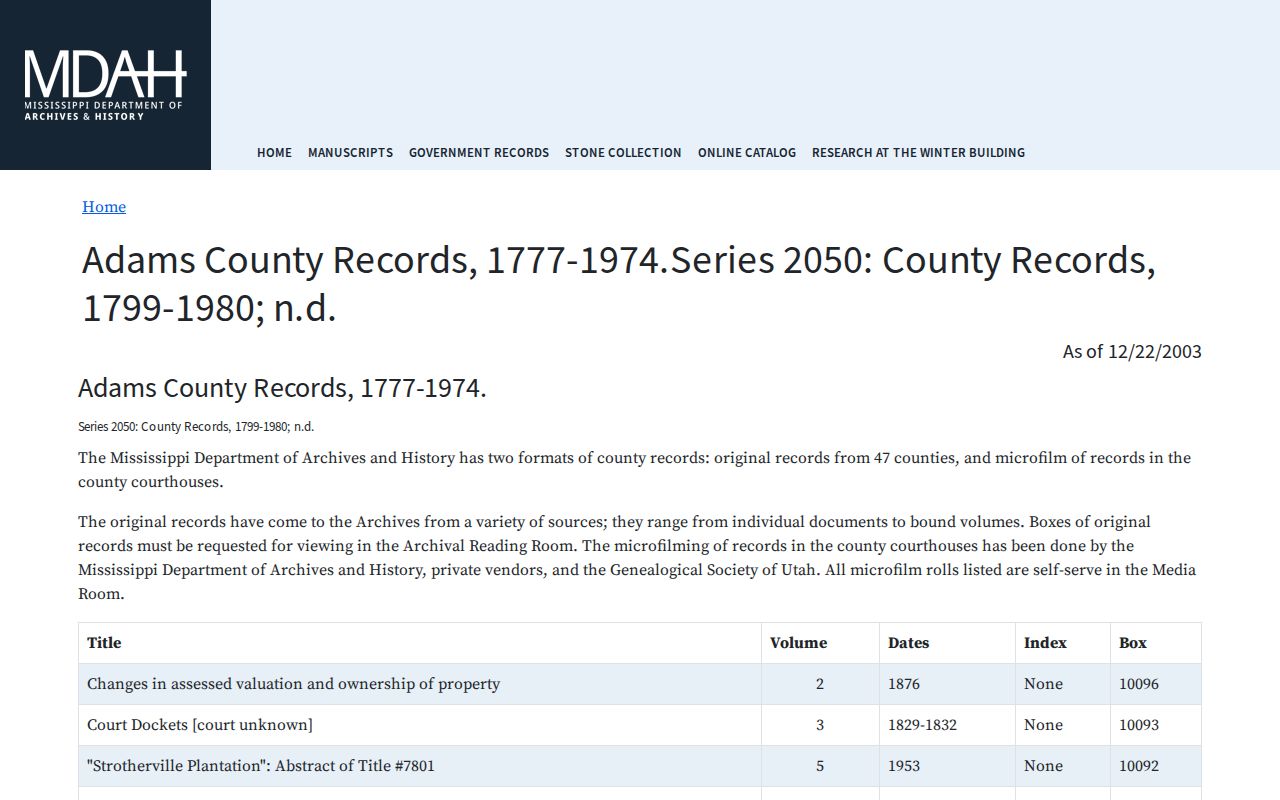
Use the catalog to cite a series and date range precisely. It should end in a targeted book, box, or reel request, not a claim that the page itself names an owner.
Plan an Adams County Microfilm Pull
The MDAH county-record catalog documents the in-person route to older courthouse books on microfilm.
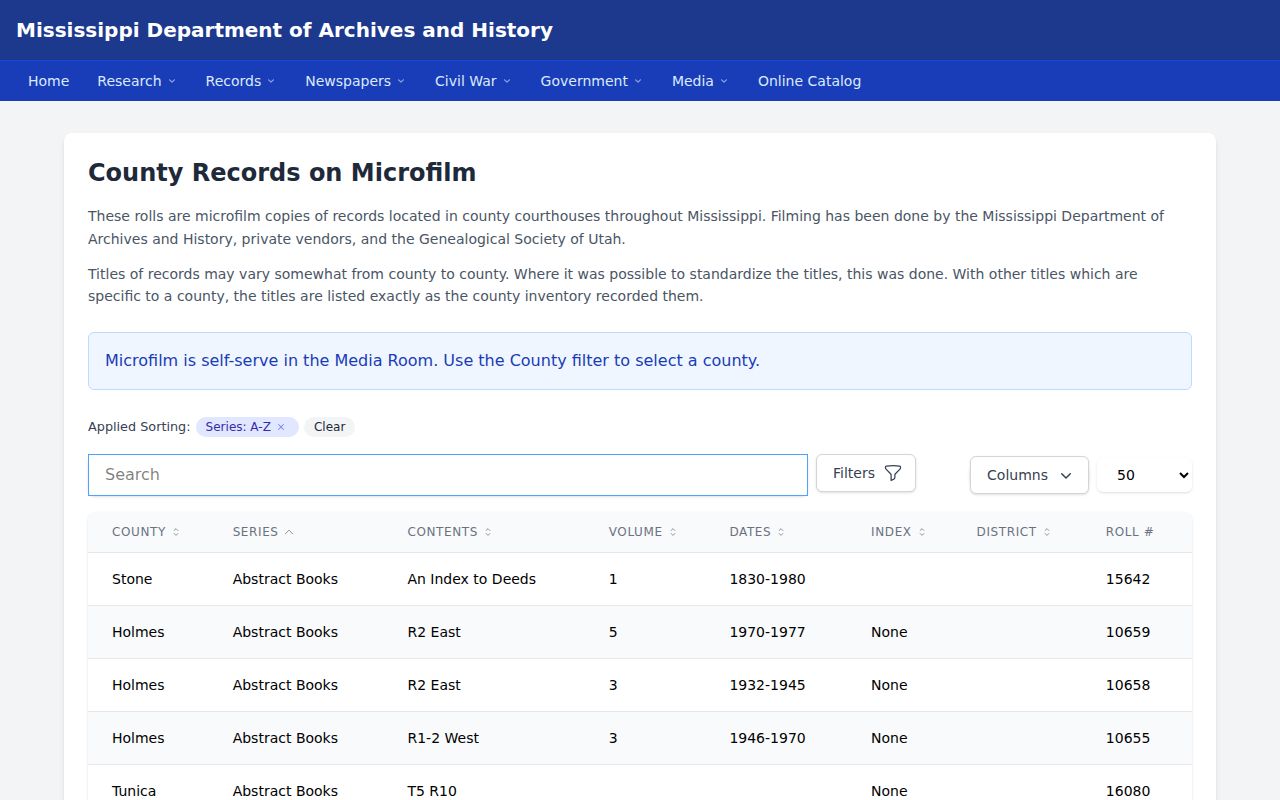
Arrive with the likely book, date range, party names, and a legal-description clue. That preparation turns a vague former-owner search into a reel-level request.
Follow Estate and Court Breaks in an Adams County Chain
Chains break in predictable places. A transfer may pass through an estate. It may also involve an executor or administrator, an heir, a partition, a quiet-title order, a foreclosure, or a tax sale. Adams Chancery Court handles both estates and land-title matters. So request the case number, will, letters, land-related petition, sale or partition order, final decree, and the recorded transfer that followed.
The estate file tells you who had authority to sell. It does not replace the recorded instrument that reconnects the chain. Search exact name variants and match the land description every time. Not every estate under a surname touches your parcel.
Bridge Old Adams County Addresses With Plats and Directories
Old addresses rarely fit the modern Natchez grid. MDAH's municipal finding aid names an 1819 Green Street plat and an 1828 lower-landing road plat. It also lists Jefferson College lots and an 1845 city-property resurvey. When a street name fails you, a plat can tie an old lot, block, or road description to later records.
Directories and newspapers add color, not title. Listed directory holdings begin in the twentieth century. Mississippi State University holds long Natchez newspaper runs. Mine street guides, legal notices, estate notices, and sale advertisements for dates and name variants. Then carry those clues back to the land record.
Note: A directory occupant or newspaper mention is context only, and former owners must be established through land and court records.
How Far Back Adams County Former-Owner Records Reach
The archive reaches back to territorial and Spanish-era material. No single series promises an unbroken chain, though. Catalog leads report Adams deeds from 1780-1886, deed indexes from 1798-1899, and Spanish records from 1781-1796; confirm the reel and source before citing any of them. Historic nominations also cite specific Adams deed and will books, and those work well as breadcrumbs rather than a full inventory.
Lawful use. Trace former owners for house history, title research, estate work, or purchase diligence. Never use historic or current address information to target or harass anyone.
A strong Adams County property history backs every link in the chain with a source. The citation should name the repository, the volume or reel, and the page, along with the indexed names, the date, and the deed type. A matching property description ties each deed to the right parcel. When a record cannot be found, label the gap plainly and keep working through Chancery, MDAH, library, or court channels instead of guessing.